


Bitcoin has once again broken records, soaring past the $120,000 mark early this week. The world’s most famous cryptocurrency is riding a wave of investor enthusiasm, policy momentum, and institutional support. But behind the price surge is a growing concern: Bitcoin’s massive carbon footprint.
As Bitcoin gains more value, it needs more energy. This raises big questions about sustainability in the digital world. Let’s dig deeper into how and why this could be the case.
Record-Breaking Rally and What’s Fueling It
Bitcoin reached a new all-time high of over $120,000 last week, supported by major institutional investments. Spot Bitcoin ETFs saw over $2.7 billion in inflows, showing strong demand from large investors. Companies like MicroStrategy have also continued their buying spree, recently adding $472 million in Bitcoin to their holdings.

Several other key drivers are behind this rally:
- U.S. lawmakers kicked off “Crypto Week.” They introduced new laws to support stablecoins, clarify digital assets, and even create a Strategic Bitcoin Reserve.
- President Donald Trump showed support for crypto during his campaign. This raised hopes that future regulations could benefit the industry.
- Technical analysts now predict price targets between $130,000 and $160,000. This depends on market momentum and sentiment.
Bitcoin is becoming more accepted on Wall Street. Its use in regulated financial products, like ETFs, is also growing. This makes Bitcoin easier to access than ever. This momentum is helping reshape the digital asset’s role in the global financial system.
The Carbon Caveat: Energy Use and Emissions Surge
Bitcoin’s success doesn’t come free, at least not environmentally. The process of mining Bitcoin is energy-intensive, as it relies on powerful computers solving complex math problems 24/7. This activity consumes a tremendous amount of electricity.
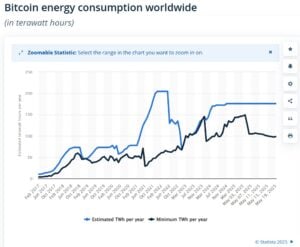
According to the Digiconomist Bitcoin Energy Consumption Index, the Bitcoin network uses around 175.9 terawatt-hours (TWh) per year. That’s more electricity than entire countries like Poland or Argentina. The resulting emissions are estimated at nearly 98 million tonnes of CO₂ annually—about the same as Greece emits in a year.
Let’s break it down further:
- Each Bitcoin transaction emits about 672 kg of CO₂—as much as driving 1,600 km in a gas-powered car.
- Bitcoin mining now accounts for about 0.7% of global CO₂ emissions.
- The International Monetary Fund (IMF) warns that by 2027, US crypto and AI could use 2% of global electricity. They might also contribute 1% to total emissions.
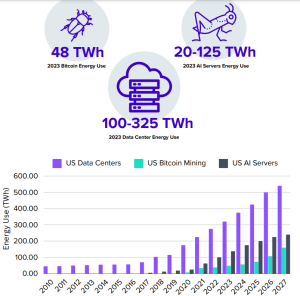
This energy use raises big worries about climate change. The world is racing to reach net-zero goals. Critics say Bitcoin’s environmental cost might be higher than its financial gains. They believe the industry needs to improve.
Green Bitcoin? Renewables and “Clean Mining” Push
In response to growing criticism, many Bitcoin miners are shifting toward renewable energy sources. A report by the Cambridge Centre for Alternative Finance found that as of 2025, over 52% of Bitcoin’s electricity now comes from clean sources. This includes:
- 23% from hydropower
- 15% from wind
- 3% from solar
- Around 10% from nuclear energy

Big mining companies like Marathon Digital, Riot Platforms, and CleanSpark are setting up near wind or solar farms. They are also trying flare gas capture, which uses waste methane from oil fields to power their mining operations. Others are purchasing renewable energy certificates (RECs) or engaging in tokenized carbon offset programs.
However, not all miners are on the green path. A 2025 environmental review showed that in key U.S. mining states—like Texas and Kentucky—up to 85% of the electricity still comes from fossil fuels.
This imbalance is a challenge. While some parts of the network are “clean,” others continue to rely heavily on coal and natural gas. And the patchy data makes it hard for ESG investors to know which projects are sustainable.
Policy Tailwinds vs. Environmental Headwinds
Recently, the U.S. is on the verge of passing a trio of significant crypto bills aimed at shaping the future of digital assets and their regulation. These laws aim to provide clarity, security, and innovation in the fast-changing world of cryptocurrency.
First, the GENIUS Act is a landmark bill focused on regulating stablecoins—digital currencies pegged to traditional money. It sets up a tiered system for issuers. It also requires stablecoins to be fully backed by liquid reserves, like cash and Treasury bills.
Moreover, the CLARITY Act, alongside the GENIUS Act, aims to set clear rules for crypto markets. In contrast, the Anti-CBDC Surveillance Act wants to ban central bank digital currencies. This is to protect user privacy and ensure national security.
These bills promote cryptocurrency adoption. They offer legal certainty and protect consumers. They are now close to passing the U.S. House with strong bipartisan support and are expected to be signed into law soon.
As Bitcoin becomes more popular, regulators are scrutinizing its environmental impact more closely. Several proposals aim to bring transparency and accountability to crypto mining’s carbon footprint.
Some of the current regulatory moves include:
- The Sustainable Bitcoin Protocol, which promotes blockchain-based proof that Bitcoin was mined using renewable energy.
- The European Union and U.S. SEC are exploring carbon intensity scoring for crypto assets—essentially labeling them “clean” or “dirty” based on emissions.
- The IMF has proposed a carbon tax of up to $0.09 per kWh for crypto miners. If implemented, this could raise $5 billion per year in revenue while cutting up to 100 million tonnes of CO₂.
These policy discussions show that environmental concerns are now part of the crypto conversation. If Bitcoin mining doesn’t improve, regulators might act tougher. They could ban high-emission projects from ESG-focused portfolios.
Some governments are also starting to link crypto mining to energy strain on national grids. During heatwaves in Texas and Canada, mining operations have been temporarily shut down to reduce demand. These events hint at the challenges ahead in balancing Bitcoin’s growth with grid stability.
Forecast: Sustainability Meets Financial Opportunity
As Bitcoin’s price keeps climbing, sustainability will become more important to its future. Here’s what analysts suggest BTC could hit:
- $130K (short-term)
- $160K by Q4 if ETF inflows continue
- $200K by 2026, per Citi and Standard Chartered
Some banks, like Citi and Standard Chartered, project Bitcoin could reach $200,000 by the end of 2026—if sustainability concerns are addressed and institutional investors keep flowing in.
But that “if” is important. Many ESG-focused funds already screen out companies that don’t meet sustainability standards. If Bitcoin mining doesn’t get greener, those funds may avoid crypto altogether.
Bitcoin’s latest rally shows its growing influence in the financial world. However, its rising carbon footprint is now under the spotlight. While over half of the network is powered by renewable energy, the remaining fossil fuel use still contributes significantly to emissions.
Mining innovation is helping, with new projects using solar, wind, and methane capture. And regulators are pushing for more transparency and accountability. Unless the entire network commits to sustainability, Bitcoin’s environmental reputation may limit its future growth.
Still, if Bitcoin can combine financial performance with climate responsibility, it could become a true store of value—not just in dollars, but in environmental integrity.