

The Attorney General’s office in New Hampshire is examining a plan proposed by Bluesource Sustainable Forest Company regarding the reduction of logging activities on a significant portion of the state’s forests as policymakers are working on bills associated with the use of carbon credits.
The area, covering 146,000 acres, was initially safeguarded for logging and recreational purposes through a conservation easement. The plan did not anticipate revenue generation through carbon credit markets, a recent development in the industry.
Bluesource, the new owner, aims to curtail logging by around 50% on this massive tract of land in 2024. That area represents about 3% of the state’s landmass.
Though the plan’s intent is to increase forest carbon sequestration, it affects local mills, loggers, the region’s economy, and potentially taxpayers.
The Value of Keeping Trees Standing
The shift towards less logging is due to the increasing value of preserving trees for carbon credits. It is a market-driven initiative aimed at reducing carbon emissions.
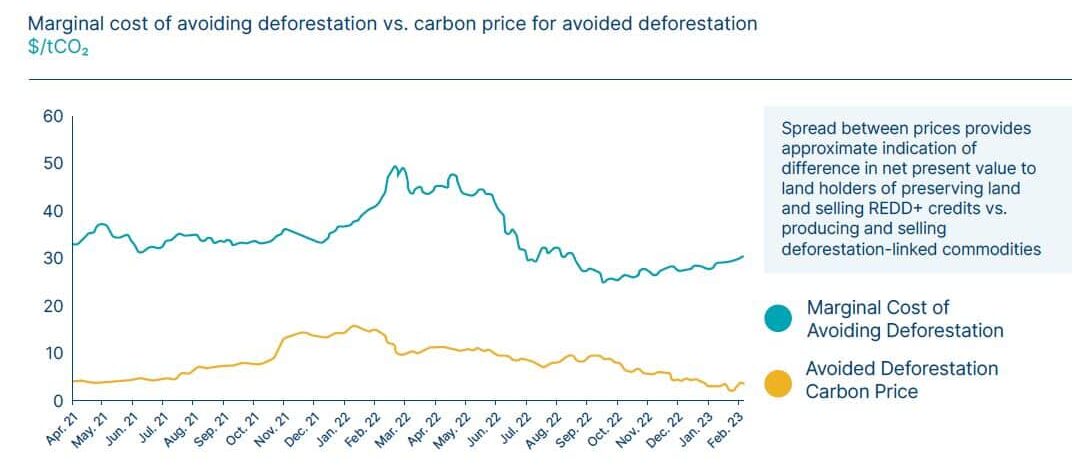
According to Energy Transitions Commission (ETC)’s report, the current price of carbon credits for avoiding deforestation isn’t enough to cover the marginal cost of avoiding commodity-driven deforestation.
 The Attorney General’s office is assessing whether Bluesource’ planned reduction aligns with the original agreement established to protect the land.
- The plan outlines the company’s goals, which are subject to the easement.
The easement acts as a safeguard, ensuring that the land remains protected from development. It also dictates how it should be utilized while outlining the responsibilities of both the state and the landowner.
From the original 171,500 acres, 25,100 acres were allocated to the state. Out of this, 25,000 acres were set aside for wildlife habitat management, while an additional 100 acres were allocated to expand the Deer Mountain Campground.
The easement guarantees public access for various traditional recreational activities such as hiking, hunting, fishing, trapping, snowmobiling along designated trails. However, it limits “non-forest activities” to a maximum of 10% of the property.
In addition to preserving open spaces, protecting natural resources, and nurturing wildlife habitats, the primary objective of the easement is to maintain the property as a financially sustainable land area for timber, plywood, and other forest product production. It explicitly permits “forest management activities,” including various methods of cultivating, harvesting, and removing forest products.
Bluesource’s move to participate in the carbon credit market wasn’t foreseen when the conservation easement was formulated two decades ago.
Promoting Forest Carbon Credits in the US
For ages, forests have been valued mainly for the timber they provide. However, efforts to combat climate change have given them an additional value by recognizing their ability to absorb and hold carbon.
Forests can trap nearly double the amount of carbon they release, acting as significant carbon storage.
In 2020, the U.S. Forest Service calculated that per acre in New Hampshire, forests held around 87 tons of carbon by 2018. Approximately 42% of this was in above-ground growth, with 38% stored in the forest soils.
When trees are cut down, processed, and used to create solid wood products like furniture or building materials such as plywood, their carbon remains stored within these products for potentially hundreds of years.
In 2003, there was no established carbon market in the US. Hence, the easement related to the Connecticut Lakes forest didn’t address managing the forest for carbon sequestration, storage, or carbon credit trading.
In 2022, Bluesource Sustainable Forest Company (BFSC) acquired the Connecticut Lakes Headwaters Working Forest, totaling a million acres managed. Thus, BFSC positions itself as “the largest private forestland owner entirely focused on addressing climate change.”
In 2021, Bluesource partnered with Oak Hill Advisors, a subsidiary of T.Rowe Price managing $500 billion in assets, to acquire forest lands, including those in New Hampshire.
- READ MORE: $1.8 Billion Bet on the Carbon Markets
BFSC’s president, Roger Williams, said that the collaboration would transition the company from developing projects generating carbon credits to becoming a forest land asset manager.
Additionally, last year, BFSC merged with Element Markets, a majority-owned entity of TPG Inc., an alternative investment manager. Element Markets describes itself as the primary creator and promoter of carbon and environmental credits across North America.
Companies that want to reduce their carbon emissions can buy the credits to offset their footprint. Each credit corresponds to one tonne of reduced or removed carbon from the air.
The Debate Goes On
Bluesource intends to reduce timber harvests by over half of what has been cut in recent years, particularly between 12,000 and 14,000 cords for the year ending April 2024.
Meetings, discussions, and proposed legislative actions are underway to address the broader consequences of the plan on the local economy. The potential outcomes could have a profound impact on the logging industry, the local community, and the area’s fiscal landscape.
In response to concerns, Bluesource is engaging with legislators and stakeholders, offering expertise and collaboration to deal with the situation.
According to Patrick D. Hackley, director of the state Division of Forests & Lands, Bluesource had submitted its revised Annual Operating Plan, noting that:
“We are now in the review process… to ensure the new harvesting plan, based on the company’s participation in California’s Air Resource Board Compliance (Carbon) Offset Program, complies with the purpose and all provisions of the conservation easement.”
Bluesource’s initiative to reduce logging for carbon credit generation within a preserved land area is raising debate in New Hampshire. The company’s move intersects with the long-standing conservation easement, provoking discussions on economic impact and forest carbon credit strategies.